Chekhov’s Gun

cropped-future-of.jpg

“Chekhov’s Gun” refers to the words of the early 20th Century playwright and author Anton Chekhov: “If in Act One you have a pistol hanging on the wall, then it must fire in the last act.”

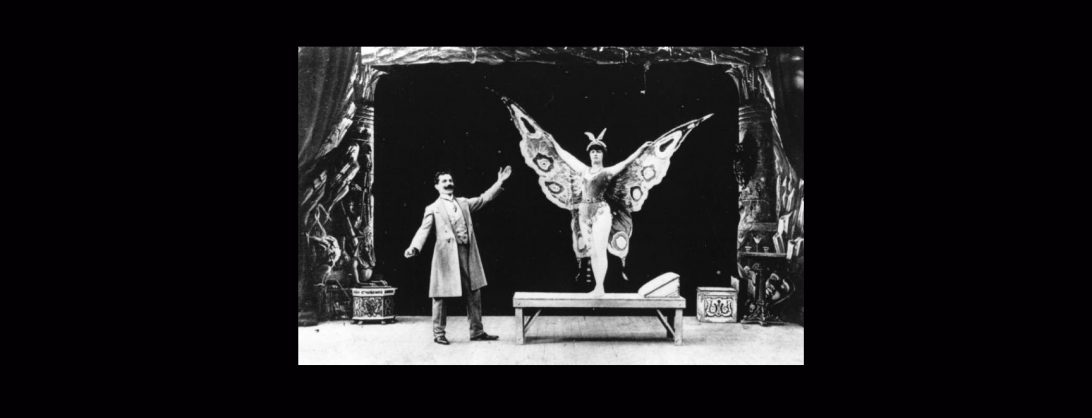
In the introduction for The Future of Art we posited that moving pictures would become the future. Georges Méliès was set as the progenitor of much we know today about magic and animation.

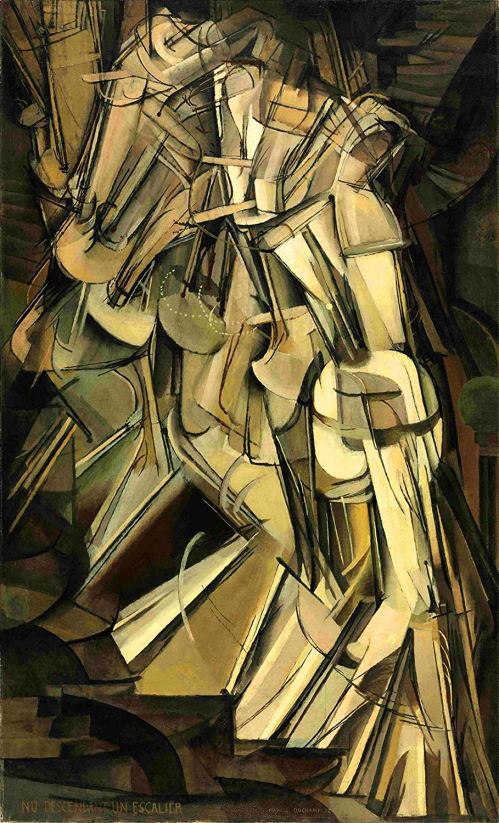
With this last act in our The Future of Art lessons, it is time to come full circle, connect the dots with Méliès and with me with a dollop of Duchamp thrown in because he was keen to poke a finger in the eye of retinal art. But, before he did, he painted one of the most famous and influential Cubist/Futurist images Nude Descending a Staircase (1912).

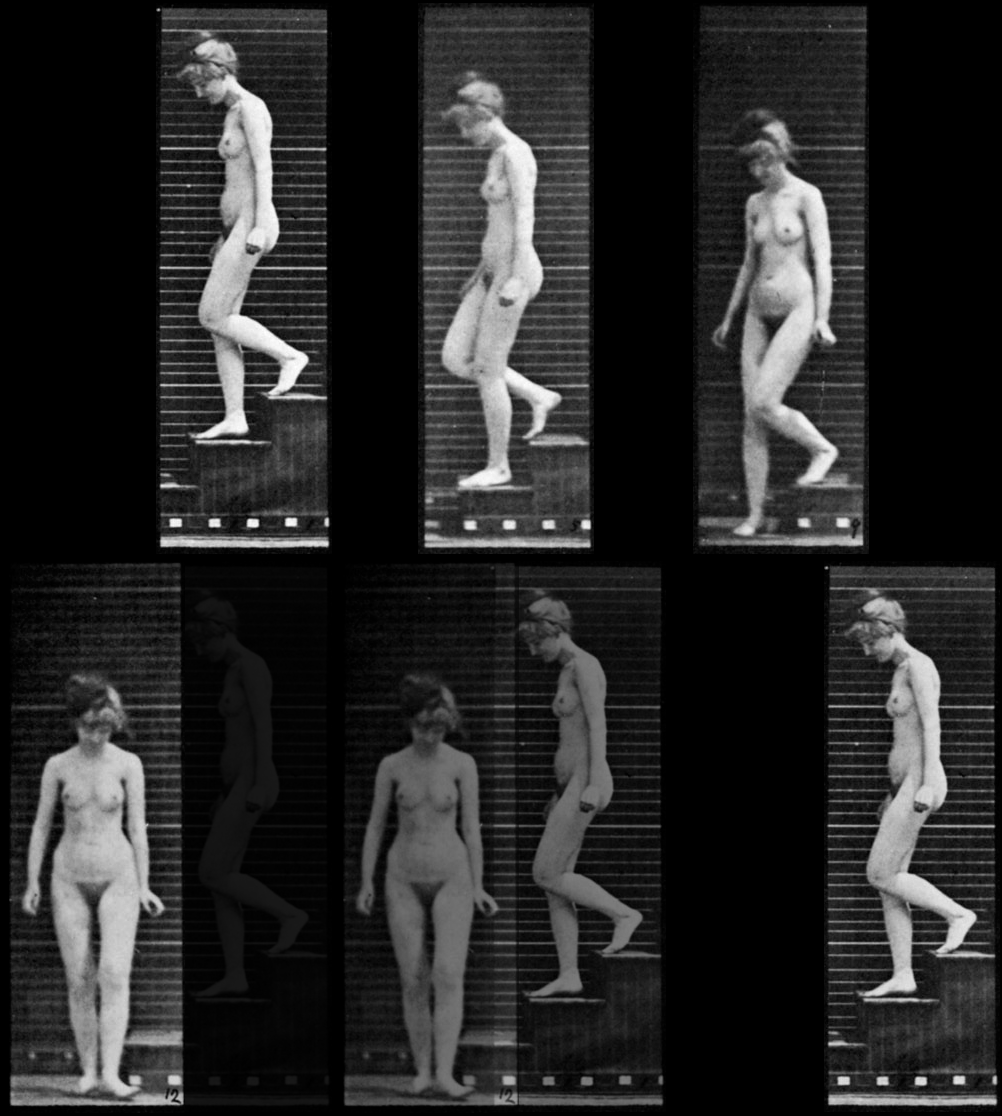
The optical effect is founded in Cubism with an added Futurist twist of motion in time. With the influence Eadweard Muybridges’ 1887 series The Human Figure in Motion along with an awareness of Étienne-Jules Marey early experiments with time-lapse photography, notice how the Nude approximates the blur one might see with time-lapse imagery.
Eadweard_Muybridge_1
Eadweard Muybridges’ series                       The Human Figure in Motion (1887)

81rQurxXzQL._SL1500_

Even Duchamp himself got in on the descending act— on display until November 10 at the Legion of Honor in Strange Days: Dada, Surrealism and the Book  Robert Lebel’s monograph Sur Marcel Duchamp (1959)

IMG_5700

Painted in 1912, the same year as the Nude, Giacomo Balla’s Dynamism of a Dog on A Leash is one of the most famous Futurist paintings. The dachshund scurrying at the feet of a woman appears to be a stop-action, frame by frame capture of an energetic moment in time.

Giacomo_Balla,_1912,_Dinamismo_di_un_Cane_al_Guinzaglio_(Dynamism_of_a_Dog_on_a_Leash),_Albright-Knox_Art_Gallery

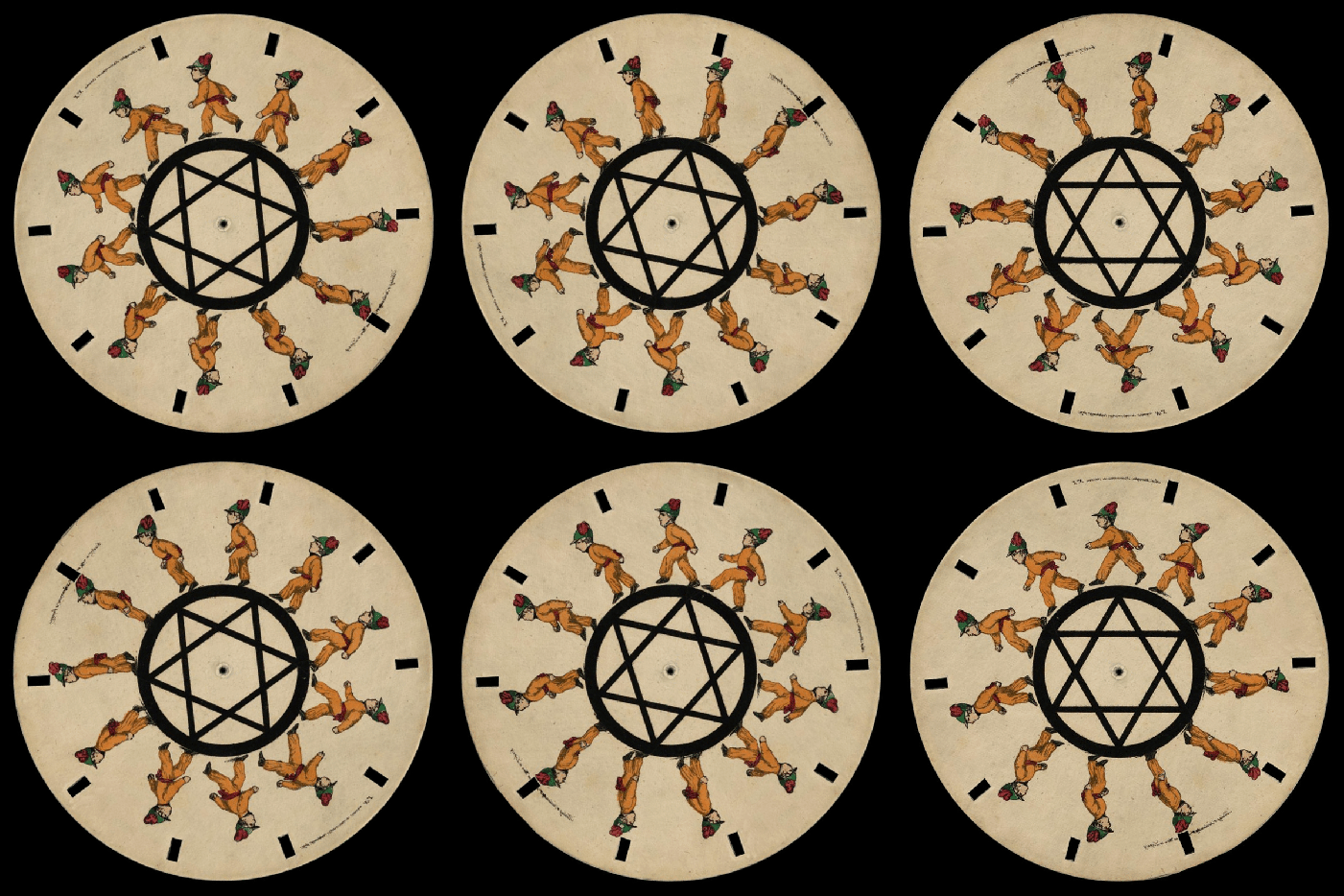
Prof._Stampfer's_Stroboscopische_Scheibe_No._X
Professor Stampfer’s Stroboscopische Scheibe No. X 1833

Many of the principles behind motion pictures were understood well before the invention of “the movies.”

In 1833 Simon Ritter von Stampfer experimented with stroboscope effects where images on a spinning disc appeared as if moving. 

In 1877 photographer Eadweard Muybridge created a sequence of 24 images of a running horse, taken by 24 cameras and, dare I say, motion pictures were soon off and running. 

In 1882 when Étienne-Jules Marey camera took bursts of sequential photographs, the basic building blocks for the creation of motion pictures were invented. 

In 1888 Thomas Edison met Eadweard Muybridge then worked to create a camera and projection system that reproduced vision the way the phonograph he was working on reproduced sound.

In 1890 French theater director and magician Georges Méliès was the first true master of cinematic techniques. His A Trip to the Moon, (1902) became the first internationally successful motion picture, and the first science fiction film. 

Movie mastermind Méliès’ animation and a number of his special effects are based on stop-motion photography. Mention must be made of the theory of the “persistence of vision” a somewhat controverisal idea that what we see is a subtle blend of what we are seeing now and what we just saw. A bridge connecting now and then makes things appear as if in motion.

Here is Méliès, sci-fi cinematic sensation A Trip to the Moon 1902. Talk about a vision of the future.!!!



Art Will Save Us. (art that is alive, that is…)

Art naturally, is no savior, but the structures that art rests on, including painting, architecture, design can help. A lot. What I mean, is, the imagination with all it’s inventive power can make the world a better place. And, not with the decorations you find in every city, so called “public art”, but in the creation of art linked with living systems. Here’s an example in the Gowanas Canal in Brooklyn, where the exemplary use of oysters has cleaned the water of a gross-out spot, that’s now on its way to recovery. There are artists like architect Kate Orff who seek to offer the sad planet a solution using the grace and gift of biological processes to palliate the woe. Oysters filter pollution, returning clean water to an ecosystem, and when well-established loose their absorbed toxicity and become delicious food. A viable and saving thought process is emerging as the way we live on Planet Earth. Here is Kate Orff giving you the lowdown.

Art is so often a node of wonder for the human race and most often depicted are images of the beauty of the Natural World. These days its usual to see nature washed over by the ravages of industrialization a la Edward Burtynsky:

nickel-tailings-34-sudbury-ontario-canada-1996

Images like this are fine and so beautiful in their own way thanks to Burtynsky’s avid eye. An artist of that power and dedication who opens our eyes to the unlikeliest confluence of horror and beauty. Necessary.

Peggy Rathman, an award-winning children’s book artist, and her husband John Wick, an architect and builder have used their visionary skills to create The Marin Carbon project. They bought 600 acres in Nicasio seeking to return it to its natural state as a gift to the world. Peggy is the scion of the Genentech fortune who wanted to return her good fortune to humanity by restoring their land to its original state. Turns out, once intensive grazing has been implemented the land is ruined for a scheme like John and Peggy’s. Hooves compact the soil and the invasive shallow-rooted oat grass make a hard pan just inches below ground. Deep-rooted native grasses don’t stand a chance. With the introduction of just 1/2 inch of compost and a carefully monitored grazing program, the land is well on its way to productivity and planet saving. The supreme bonus of this restoration is that the carbon breathed by the grasses stays in the soil creating a natural carbon sequestration. Two creative souls at work. Like I said, art will save us.

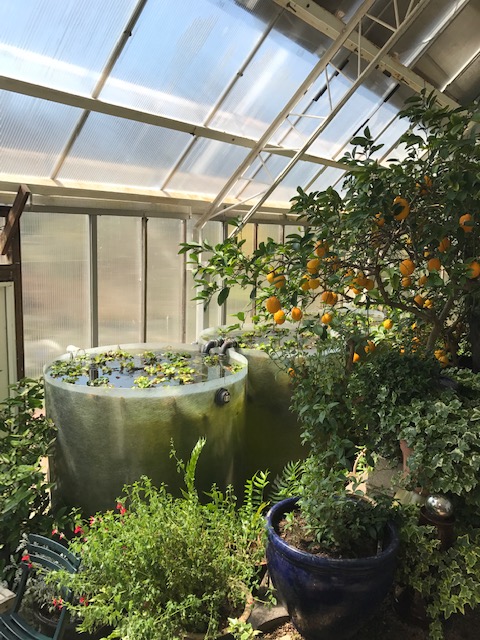
Art is maybe not that thing on your wall, in the corporate board room, taking up space on the mall plaza, art is, as we’ve said it before, where creative thinking is born like The New Alchemy Institute in Woods Hole, MA. I first visited this project in 1974 and got a first-hand look at The Ark. Here is a picture from our visit in 2016, much the same as I remembered, thriving and bustling with ideas. The Ark is a living space that integrates design, beauty and the thrill of seeing something brand new even if it is 50 years old. In the harsh New England climate the new alchemists have created a living house that is not only beautiful and refreshing to inhabit, but the house itself produces food! Here’s picture of the interior showing fish tanks growing tilapia, the water from which will nourish the interior garden.

IMG_0501
The living room of the Ark—anyone for orange glazed Tilapia?

Finally on our tour of living-systems inspired art work, we come to The Last Resort, the brain child of David Hoffman. His 2.5 acre property is devoted to the idea of finding meaning in living systems. For 45 years Hoffman has been building relentlessly, basing his design ideas on his ten-year journey through Asia. The place is a wonder to visit, and plans are afoot to turn the place into public workshops on design, sustainability and the wonder of life. Don’t let anyone tell you that art has no practical value. David was the first friend I made when I moved to San Geronimo Valley.

David has been under siege by the Marin County building department for 40 years and plans are being hatched to turn his property over to a non-profit entity that will become the care taker of his legacy and his vision for the future. A board has been formed to accomplish this. Yours trulies are on that board.

So we see the creative mind at work with the prime goal: make it beautiful first.

Utopia

moreutopia-wl

My interest was piqued when, in my senior year in high school (1968), in history class we were given an assignment to write a book report about a document of our choice.  How or why I chose Thomas More’s Utopia (1516) I can’t now remember but I did and that reading sparked my desire to live a different kind of life. I did not want that Monsanto House at Disneyland nor did I want to spend my time in the dull of Sacramento suburbia. I wanted to be a part of a bigger vision. I longed for an idyllic country life where all of my chickens had names and I knew the names of all of the birds in the sky. I wanted to go “back-to-the-land.”

Along with writing about More, I took a look at past examples of small communities of people united in a common purpose: the Oneida Community (founded 1848) in New York and the Amana Colonies (built 1855) in Iowa. 

With the advent of the Whole Earth Catalog and the Mother Earth News my interest was informed by these how-to, DIY publications. I discovered that my personal longing was part of a larger social movement. There were many others like me, re-thinking how to live lightly on the planet. A variety of intentional communities, collectives, co-ops, communes, co-housing were established, each presenting a model lifestyle for humanity, showing ecological ways for people to share resources and live peacefully together. Still extant: The Farm in Tennessee (founded in 1971) , The Lama Foundation in New Mexico (founded in 1967), The New Alchemy Institute in Wood’s Hole (founded 1971).

Joel Sternfeld’s photoessay and accompanying text Sweet Earth: Experimental Utopias in America, records the win/lose of hope and resilience and in some cases demise of some historical and contemportary examples.

After doing my time in college, I couldn’t wait to get out of the smog-laden Los Angeles basin. On the search for a new place to settle, my journey took me north, yes, north to Alaska hitchhiking through the Yukon. Those days my anthem L.A. Freeway sung loud was:

Adios to all this concrete
Gonna get me some dirt road back streets

After going the distance to the Arctic Circle (thoughts of interminable winter darkness and cold did not fit with my vision of utopia) I returned south to California, ending up on Mt. Veeder on the west side of the Napa Valley. We were not a commune or an organization but rather a loose association of  “households” on 40 acres who shared a vision of living as simply and as sustainably as possible. 

We built “handmade houses” a yurt-like structure, a mushroom shaped pod using creative construction, imagination and insouciance — outside the constraints of standard building codes. 

We lived off the grid — no electricity, water piped from a nearby stream.

We were devotees of bio-dynamic gardening ala Rudolf Steiner.

We wanted to raise goats and chickens.

Since we were a group of college-educated folks, not country bumpkins/ hicks we had what we thought were smart (smart-aleck?) ideas about animal husbandry. We thought we knew what we were doing. We experimented with ways to enhance chicken performance to maximize the production of our own fresh eggs.

Our birds were ordered from a glossy- color catalog from a hatchery in the mid-west. Before making our selections we poured over that booklet (like we did the seed catalogs). We wanted our brood to be not only good layers but good to look at  — think heraldic feather crests. From the hatchery’s offerings of rare and ornamental varieties we decided on furry-legged Cochins, elegant Silkies, blue and green egg laying Arucanas and some solid Leghorns.


From the Illustrated Book of Poultry by Lewis Wright

Since we had postal service only via our P.O. Box, the peeping package arrived at the USPS office. I can still remember the astonished look on the clerk’s face as he slid the noisy box across the counter.

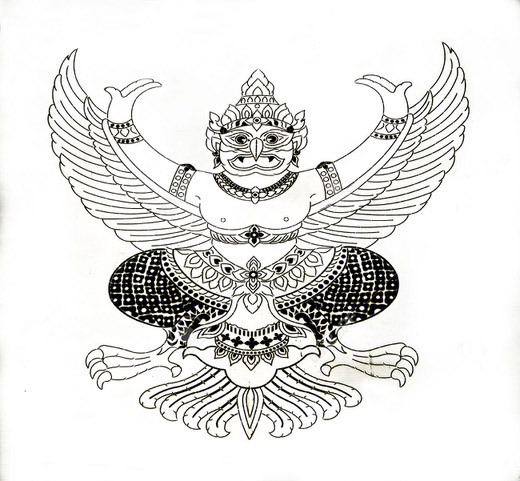
Our ideas about how to raise more robust chickens and boost their IQ were inspired by B.F. Skinner’s behavioral modification theories and his infamous training box. So along with the warm light in their cardboard incubator box, our chicken SEC (sensory enhancement chamber) included ramps, balls and mirrors, and a variety of stimulating toys strategically placed for their amusement. Looming large over the training area, to inspire our little flock to greatness was a picture of the mighty Garuda, the Hindu bird-god.

Pattern Line of garuda on white background


We were sure that lots of human handing and human names —Henrietta, Gloria, Pecky — would enhance their intelligence and make them less vulnerable to the foraging and ravages of raccoons. Needless to say, the efforts were not particularly effective. In the dark of night, one by one the grown chickens were plucked thorough the wire fencing. A bloody ruin of carcasses on one side of the fence…a tuft of feathers on the other.

Not so smart.

We hoped that all this special care might actually increase their IQ. HA! They still got eaten by the raccoons.

Even Thomas More, back in 1516, describing the agriculture and husbandry of Utopia, had ideas about the behavior modification of chickens:

They breed an infinity of chickens in a very curious manner. They are not hatched by hens, but a vast number of eggs are hatched together by means of an equable artificial warmth; and no sooner do the young quit the shell, than they consider their feeder as their dam, and follow man as other chickens do the hen.


Any discussion about chickens must conclude with a joke. OK! OK!

What do you get when you cross a chicken joke with a joke about the future?

I dream of a better future, a future where chickens can cross the road without being asked why.


And one more for the future:

The past, the present, and the future walk into a bar….                                                              It was tense.


The Weight of Politics—The Future of Art

image
The illuminated logo of Salesforce seen everywhere in downtown SF—the “cloud” seems so weightless.

From the mind in the caves 40,000 years ago, to the standing stones of Gobelki Teppe (12,000 BCE)

on to Stonehenge (3000 BCE)  then the pyramid of Djoser (2300 BCE) and the monuments scattered around the Mediterranean, then onto the Acropolis, the Roman Forum and Angkor Wat, all signify power. From the royal palaces of China to Europe’s High Gothic Cathedrals to the great towers of skyscrapers in our era—a pile of stone signifies power. Salesforce Tower is the latest fist into the sky. “I am here, I am mighty…you can join me or be a fleck of dust.” “Be a part of the cloud” they tout high on every building surrounding the Salesforce building. In neon lights. What does Salesforce want? What do they do?  How do we figure this one out?

Imagery fluency is what we are after here. We need this as we try to parse the confusion of the new millennium. One false move in IMAGE land and you are toast.  At the third debate when Trump was stalking Hilary around the stage, it was required that she turn and confront the beast—BACK OFF, BUSTER! was all she needed to say and the Oval Office would have been hers. Analysts proclaimed her the winner of the debate but Hilary lost because she failed the basic course in pictures.

In 1970, we saw the end of the modern game—shaving the log of meaning down to a toothpick. We wanted essences. The image was the image of no image. Then suddenly there were no more manifestos, declarations, no more schools of critical thought (Minimalism, Cubism, post-painterly abstraction). We were floating, trying to find a hand-hold, a driving wheel. Critical to this move to END-GAME art was the great MOMA curator Kynaston McShine. His exhibit INFORMATION at MOMA set the stage for the ascendancy of conceptual art (in essence a spiritual gesture later hijacked by materialist banditos). As we enter the era of data über alles it is super important to realize we are at the crossroad of data and information, the blinking yellow light reminding us our final destination is meaning. The meaning tool-kit from art we use to pry open ideas of mortality and loss, of energy flow through living systems, of forgiveness, of our relationship to the natural world.

And here is a PDF of Lucy Lippard’s fine follow-up to McShine’s work The Dematerialization of the Art Object —look and feel the history…

And here’s good ole’ Emily Dickenson—the original Punk Rocker of the 19th Century.

She knew her pictures, nuf’said…

The Brain—is wider than the Sky—
For—put them side by side—
The one the other will contain
With ease—and You—beside—

The Brain is deeper than the sea—
For—hold them—Blue to Blue—
The one the other will absorb—
As Sponges—Buckets—do—

The Brain is just the weight of God—
For—Heft them—Pound for Pound—
And they will differ—if they do—
As Syllable from Sound—


Que Será, Será

My grandmother’s upbeat philosophy of life was guided by the simple phrase, When life gives you lemons, make lemonade. She was always a glass half-full kind of gal and wanted to encourage in everyone a positive can-do attitude in the face of adversity or misfortune. 

Her recipe for success: lemons may be sour but with a dash of sugary sweetness they can be turned into delicious glass of refreshing lemonade.

And she often hummed the Doris Day classic Que Será, Será from the Alfred Hitchcock film The Man Who Knew Too Much. There was something optimistic in her ideas about just letting the future be what it will be. But along the way I lost sight of that simple philosophy.

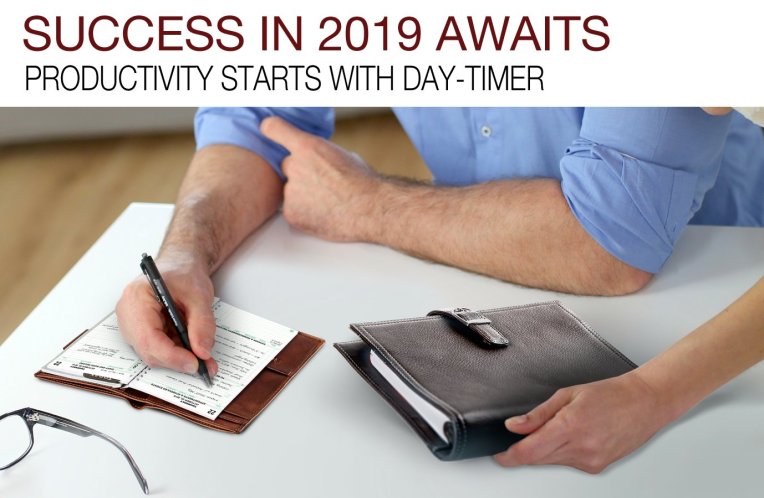
In my ambitious 30’s, 40’s I was obsessed with going somewhere, getting somewhere. Goal setting was a big part of that obsession. I had my 1 year plan, my 5 year plan, my 10 year plan, my big future plan. I kept charts and graphs. I kept calendars. I kept lists. Motivational speakers and workshops cajoled and cheerleaded me into consciously creating my future. A DAY-TIMER® purse calendar was my friend and time management  ideas help set my goals. I believed that by setting a goal and diligently working away at it was the best way to proceed. The Interent abounds with advice about how to get started. I took all of these to heart:

  • Set Specific Goals. Your goal must be clear and well defined. …
  • Set Measurable Goals. Include precise amounts, dates, and so on in your goals so you can measure your degree of success. …
  • Set Attainable Goals. Make sure that it’s possible to achieve the goals you set. …
  • Set Relevant Goals. …
  • Set Time-Bound Goals.20190102_HeroImage_DTV2_main


The days leading up to New Year’s Day were spent reviewing my accomplishments, calculating my success for the year past and setting my course in categories for the upcoming — work, career, relationships, exercise, art.

But one year, at the cusp of the year, I had a life-changing revelation. As I reflected back, I realized that the best things that had happened during the past year were surprises, unplanned happenstances, not envisioned, not on my list of goals.

Serendipity was the key. (what will be, will be) Then, using the happy accident, maximizing the unexpected, became my strategy as I transformed accident into opportunity.

In 1999, meeting a partner/husband was far from my mind but, on the fateful day I met Richard, my whole life changed and so much for the better. On that momentous first date…

One of the great pleasures of going to the beach is in the not-knowing. Not-knowing what what will be found and what kind of creative response that find will inspire.

The Pleasure Principle

Art is pleasure in the largest sense, whether visual pleasure or thinking pleasure. Connection to art makes for happiness.

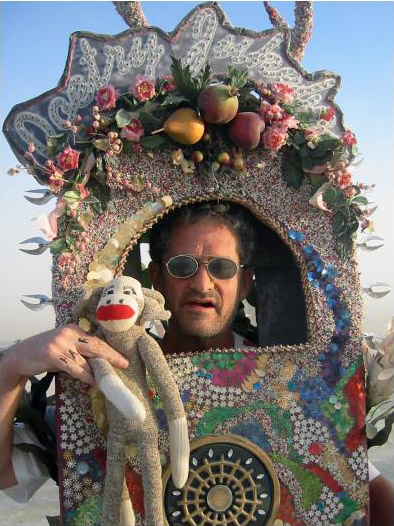
Here’s a little story about The Poetry Jukebox, illustrative of the future of art. The Jukebox is a performative act I offer as an auction item at fundraisers. 144 memorized poems are at the ready to be spoken in a one-on-one moment. Ask a “life question” and out rolls the verse. Here is the outfit that goes with it.

poetry-jukebox2007
The Jukebox performing at Burning Man 2007

At the Friends of the Petaluma River shindig, a few years ago, our congressman Jared Huffman bid and won me—an hour of poetry at his party; paid but never collected. It bugged me (debt owed and lingering) and I pestered his office (a bit) but no response. Time marches and a few years pass. So, at our Town Hall on Monday 8/5/19, I cornered him in the parking lot after the event as he was leaving. We are in Point Reyes Station where the town clock chimes with MOOOOOOOO at high noon. Green thickly forested hills, fog rolling in, tinged pink with sundown…. “Hey Congressman, you never collected…etc etc”

“OK OK, we’re running late…just give me some Allen Ginsberg…”

Howl for Carl Soloman came spilling out as if he had dropped the needle on the record:

I saw the best minds of my generation destroyed by madness, starving hysterical naked,dragging themselves through the negro streets at dawn looking for an angry fix,

angelheaded hipsters burning for the ancient heavenly connection to the starry dynamo in the machinery of night,

who poverty and tatters and hollow-eyed and high sat up smoking in the supernatural darkness of cold-water flats floating across the tops of cities contemplating jazz,

who bared their brains to Heaven under the El and saw Mohammedan angels staggering on tenement roofs illuminated,

who passed through universities with radiant cool eyes hallucinating Arkansas and Blake-light tragedy among the scholars of war,

who were expelled from the academies for crazy & publishing obscene odes on the windows of the skull….

I got that far, and then I said, uncensored (Ginsberg smiling approval in mythy clouds overhead),

“That poem ends with a whispered MOTHERFUCKER!! as so many of his do….”

Huffman flashes a giant white-teeth grin of joy and relief that I’m not asking more of this public servant than to live for a moment in art. And his political show-case smile becomes part of the scene as he and his admin haul themselves into the Suburban. Paid in full I said. A day in the life of the struggle to die happy. 

A clue comes around to explicate this die happy business. Have an idea, realize it in the material world. I tuck away this moment into the file of “happiness beyond its opposite”. Happily here in the parking lot of the Dance Palace in Point Reyes Station, California. Art will not cure injustice, heal the lame, bring down despots and Mafiosi. Nor feed the hungry or right the ship of state. Art is for pleasure, mostly.

<><><><><>

1970 saw “The end of Art, the end of history” according to Arthur Danto, Sherrie Levine, Jack Burnham and a boatload of French post-structuralists. The end of meaning, the end of metaphor. Art Degree Zero. We’ve had fifty years of the “End” But what of the struggle to die happy? Are we? Are we struggling to make this “die happy” a reality? How does art help in this regard and we come to the question of what is human happiness? Are humans the only creature who think of this? Dying happy? Or better, living happy? Does art answer?

This was the question of 1970. Now that we had entered the pointless forest of post- modern, did art help answer? I feel the room fill up with figures offering perspectives. The English skeptic too cool to be bothered, having better things to do like perching on a high stool casting lifelines to those drowning in the high water of foolish optimism. Like the new-age tout saying love is both the question and the answer. A yawning chasm splits open. Filled with? Filled with a yawning chasm. Art won’t cure the suffering of the world—art can only make you happy—its own reward.

What goes round…

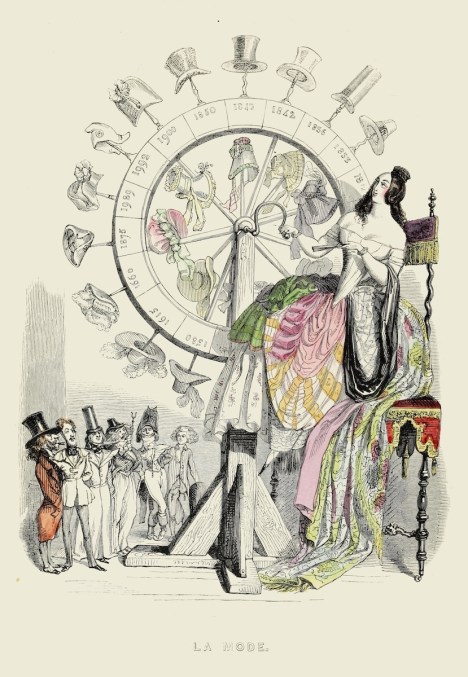
There is a timeline for this and a timeline for that. They come in circular and in round – linear and omni-directional. When I found J.J. Grandville’s timeline of stylish hats I tipped mine and LOL. What goes round, comes round.

44013003975_63341e6482_o

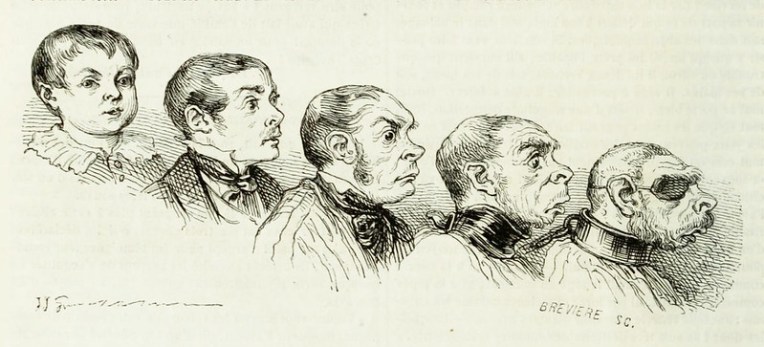
Grandville made all manner of illustrations, topical to his times and his interpretation of time. Charles Darwin’s Voyage of the Beagle had been published in 1839. Grandville’s Man Descending towards the Brute and his Portraits Compared were riffs on and interpretations of evolution. Did he look towards progress/evolvement or does he project the slippery slope of devolvement?

44205304184_63f786a652_cMan Descending towards the Brute, from Le Magasin pittoresque, April 1843
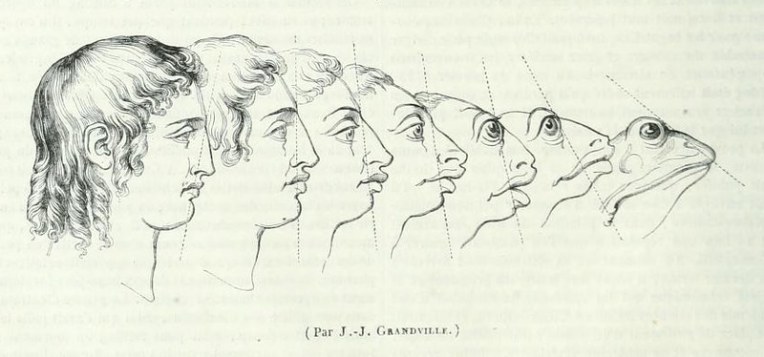
44875502032_96377d51ea_cPortraits Compared, from Le Magasin pittoresque, August 1844
 

Clock of Eras2


The Clock of Eras is here to help us visualize geologic time. It is almost impossible for the human mind to comprehend the amount of time that it has taken for the Earth to develop to its present state, yet we try to imagine each stage of its unfolding and the time that passed during each phase of development. The Cenozoic is the era we live in, though we could hardly say this is the era of humans. We have been present as a species only about 1.5 million years of the 65 million years of the current era. That represents about 7 seconds (in red) on the clock of eras!

Humans = only seven seconds. And you and me = even less than the blink of an eyelid.

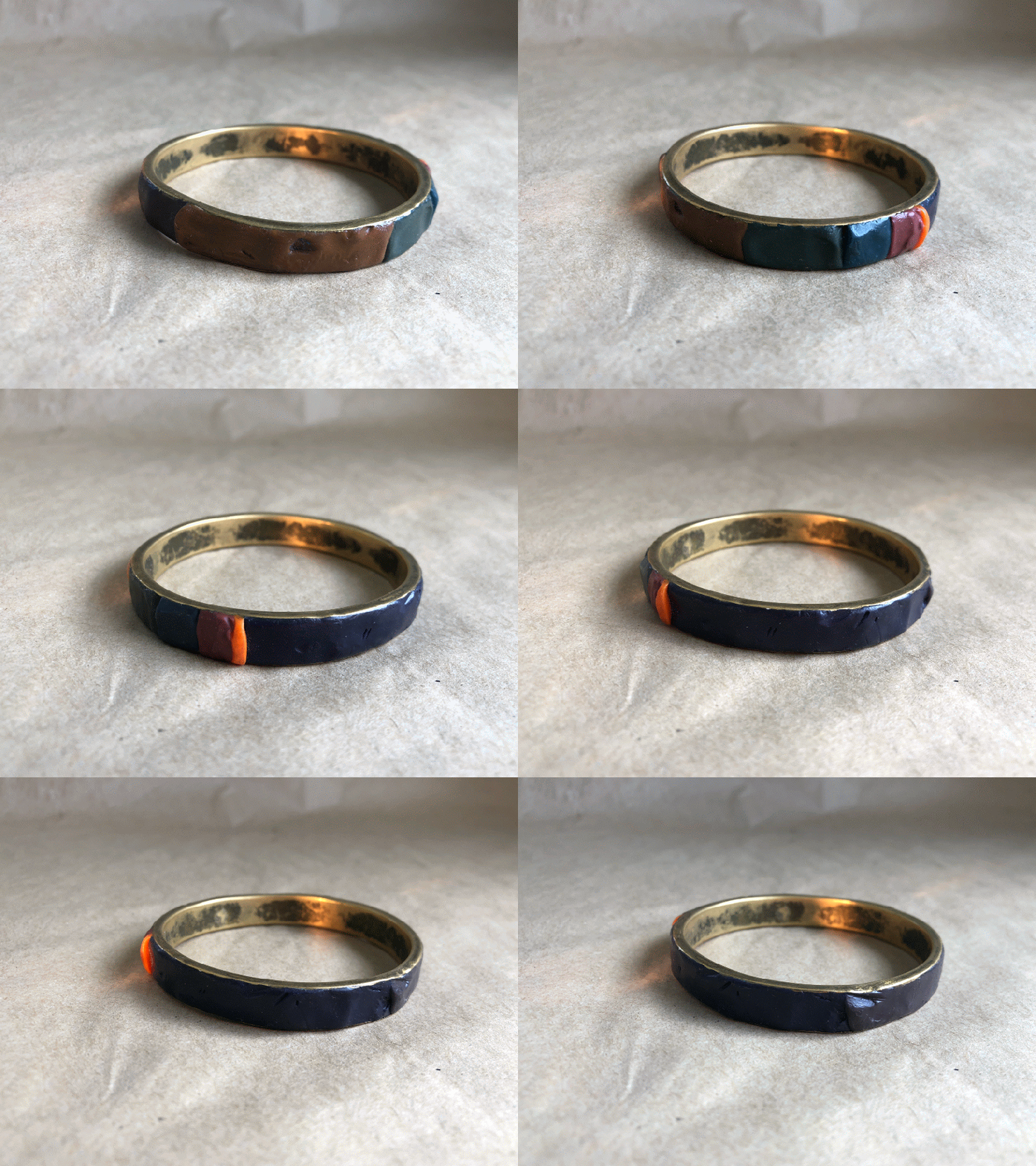
In my own go-round with time I created a Geological Timepiece, the watch I wear when I want to know my place in the great scheme of things. When I want time of my life to be put into proper perspective.

On this bracelet the thin slip of orange, a hair’s breath, represents the amount of time we humans have been on the planet. As this bracelet turns, it passes by each of the eras.

To contemplate the vastness reminds of the importance of finding meaning in our own smallness because being human, human being is a big deal.

7812CF58-7859-484D-A78C-3D24E405E462


What goes round, comes round…

Art and Capital—Part 348

OK, we’re so over Post Modernism, aren’t we? Well, if we are, what exactly was it? We think it was the banal coupled with ennui founded on a foundation of money culture, where value was best expressed by the cynical pile-up of wealth, abstract glowing cyphers on a screen. Meaning becomes provisional, no grand ideas save that being was meaningless—images that could have had bearing, sailing away like lost kites in the wind—more coming right along, and then the next and then the next. Things of value gusting off as a confetti so that the only thing seeming to have value was money itself.  Art lost its value as something to help develop the soul, something that could shine into the corridors of the mind, into the dark halls of the body with its feelings, into the joie de vivre of spirit, joining the dance of dark and light. “Well, money is something, it’s a basic flow, and me I am the archetype of jewels and dough,” says “His Highness King Gold” and “Madam Silver” his Queen. “They keep it all a-rustling with their Dollars and Pounds, everybody knows that money makes the world go ’round.” This from The Incredible String Band, c. 1968. In the 60’s some of us were absorbed into suffering the guilt of being among those who had too much in an ocean of those who had too little. All manner of goofy schemes rose up, communes and collectives, the “War on Poverty” as images of money replaced the image of the gods; we’ve been striped of every value save market value. The Trump’s apartment in NYC—a golden emptiness. Nothing to eat as the teeth clink on a wedge of golden pie. Does the name Midas ring a bell?

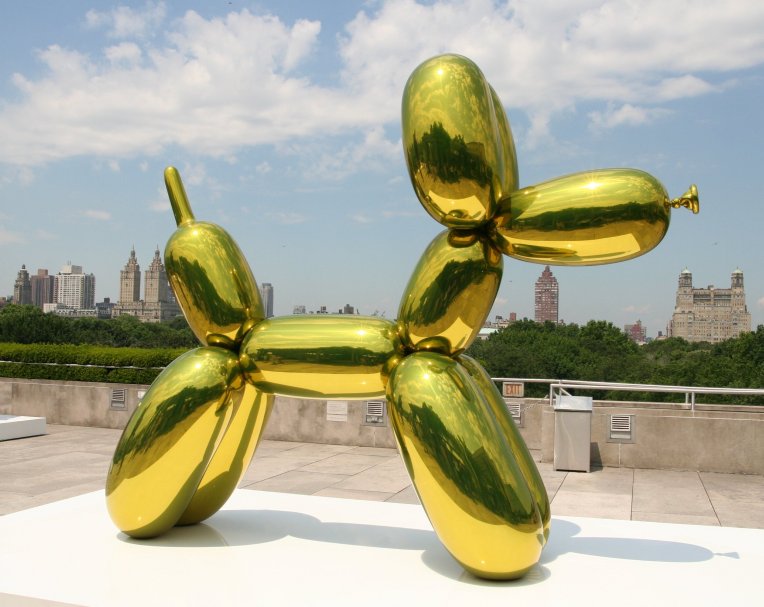
This Jeff Koons’ Balloon Dog is the epitome of value in the age of the twilight of the gods, Götterdämmerung. So that Trump Tower becomes aspirational. BOTH truth and beauty blown away. There is no salvation, no development. The old gods are dead, the new god says, “Get as much as you can while you’re here.” Some smokey whisperer telling ancient truths just doesn’t cut it as we gather ’round the new golden calf of Jeff Koons’ Balloon Dog. Fetching $160,000,000 at auction.

Jeff-Koons-Yellow-Dog-on-the-roof-of-Metropolitan-Museum-of-Art-in-New-York-City-in-October-2008.jpg

This scene from the 1956 The Ten Commandments lives in the land of naive kitsch unexamined and soon after, Moses comes down from the mountain hurling the god-wrought stone tablets smack onto the calf. Of course, the ground opens and the calf is swallowed in volcanic flames as the LAW takes the place of the idol in the biblical fairy tale. In our provisional world of get-mine-first the Law devolves from a civilizing energy into a pry-bar opening an abstract advantage over the other. Tacticle delays in court proceedings are about this usage of the IDEA of law and justice, often for unjust purposes…

How can you look at Koons’ Balloon Dog and not think of the biblical calf. When art becomes translated into money there is a garble of meaning. You can’t cynically shrug away the statue of Lincoln sitting in his DC memorial or the near-by Maya Linn Viet Nam memorial as you can the Balloon Dog. It’s the very point of Koons’ dog as an artifact of the Pointless Forest. Memorializing what…?

The flow of history moving to the future finds some wishful thinking and some despair, but if art is to retake a place of real value, meaning beyond money, it will re-emerge. It feels dire these days with “newspeak” dominating discourse, nothing of real value is spoken. But, we remember the only gold worth anything is The Golden Rule.  A revival is being born as we rediscover timeless value. The orange grotesquery occupying the White House is but a tiny speed bump as we navigate toward planetary and cosmic thinking. Let’s dance our way into the mystic, shall we? It’s about time.

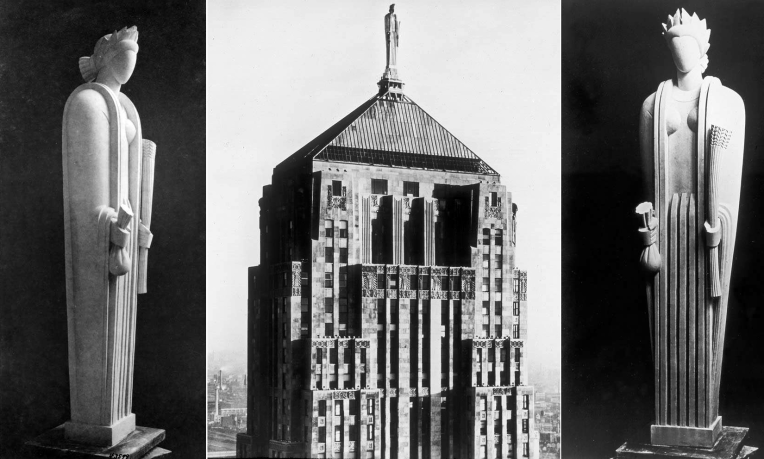
We’ve been through the “twilight of the gods” with the Post Modern cascade of nihilism. We see artist Richard Prince, that arch nihilist from the Eighties, coming full circle with his collecting mania focused on archiving the original texts and ephemera of Beatnik, Punk and Hippie eras in leather-bound clamshell boxes. Those three eras reflected the pull of culture to recapture something of lasting value. High atop the Chicago Board of Trade stands the Goddess Ceres (Demeter to the Greeks) holder of the energy of grain and increase.

image.png
Ceres 25 feet high atop the Chicago Board of Trade

There may be trouble ahead…but let’s face the music and dance. Let’s welcome back the gods! That’s a future worthy of life.


Tomorrowland

Jselby-001 

These days we are nostalgic for the future that might have been.

On July 17, 1955, with lots of hoopla and fol-de-rah, Disneyland opened in Anaheim, CA. As an enthusiastic fan of The Mickey Mouse Club (I tuned in everyday), giddy was the word to describe my thrill when my Dad announced that we would be going to Disneyland in the summer of ’56. It was to be one of the highlights of my young life.  

Jselby-012

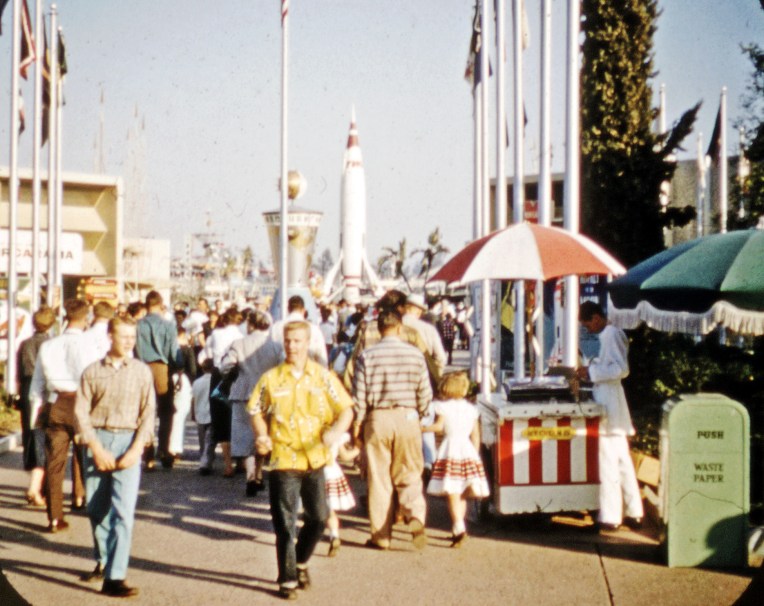
The photo of Flying Dumbo and the entry way to Tomorrowland were digitized from reels of photographs my dad took using his stereoscopic camera the 3-D View-Master. Seven pairs of stereoscopic color film images were mounted in a cardboard disc, which when viewed in a View-Master hand-held viewer or projector combined to give the picture an illusion of depth. 

The then very modern 3-D technology gave a realistic and dimensional glimpse into the future. Stereoscopes, using pictures cards known as stereographs, had been a popular parlor entertainment since the 19th century. With the advent of the camera and the stereopticon projector, the idea of ”visual storytelling” was spawned that sparked the idea of moving pictures and film.  

Today via virtual reality we can put ourselves in the picture having experiences that are taking place within simulated and immersive environments that are similar or completely different from the real world.

Back in the day, for everyday viewing, we had a hand-held device. For family entertainment we had the funny red-cyan glasses that we would don then project the reels onto a screen with special surface that reflected the polarized light that came from with a dual lens projector.   


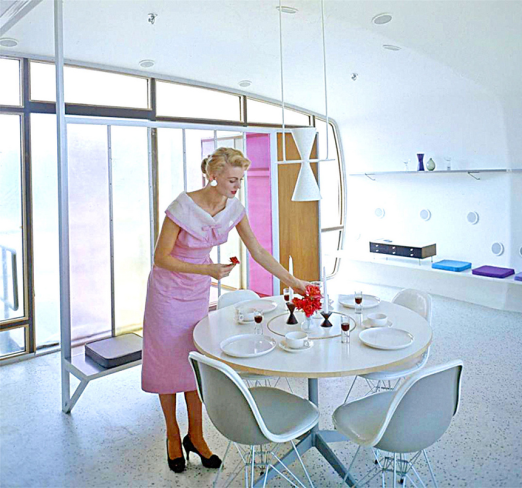
In the midst of dancing Goofy’s and adults with big mouse ears, spinning Madhatter teacups and the promise of the “Happiest Place on Earth,” Tomorrowland was designed to give visitors a walk-through experience of what life would be like in the future of 1986. Monsanto wanted to promote its plastics and Disney Imagineers wanted to incorporate a full-scale futuristic home, so these ideas merged together to form the House of the Future. The modular fiberglass home was prefabricated then assembled on-site. The house featured such farfetched conveniences as a microwave oven, ultrasonic dishwasher, cold areas in place of refrigerators and freezers, dimmable ceiling lights, climate control. Synthetic polymers in plastics, paints and fibers permeated the space. Almost everything was made of plastic — from the Melmac dishes to the durable laminate flooring.

Ultra-modern almost entirely synthetic. It’s was/is the future… 

8

Although 1986 is long gone and I do not dress svelte or chic or couture in a pink pencil dress with a boat neck collar I do have an keen appreciation for plastic. It is, as Bernard Cooper writes, in Maps to Anywhere:

“It was the permanence, the durability of plastic that made the Monsanto house a marvel.”