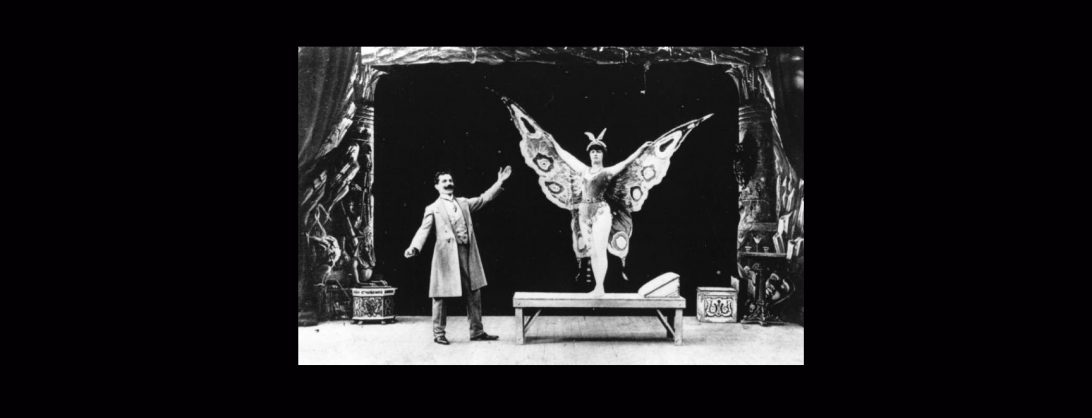
“Chekhov’s Gun” refers to the words of the early 20th Century playwright and author Anton Chekhov: “If in Act One you have a pistol hanging on the wall, then it must fire in the last act.”
In the introduction for The Future of Art we posited that moving pictures would become the future. Georges Méliès was set as the progenitor of much we know today about magic and animation.
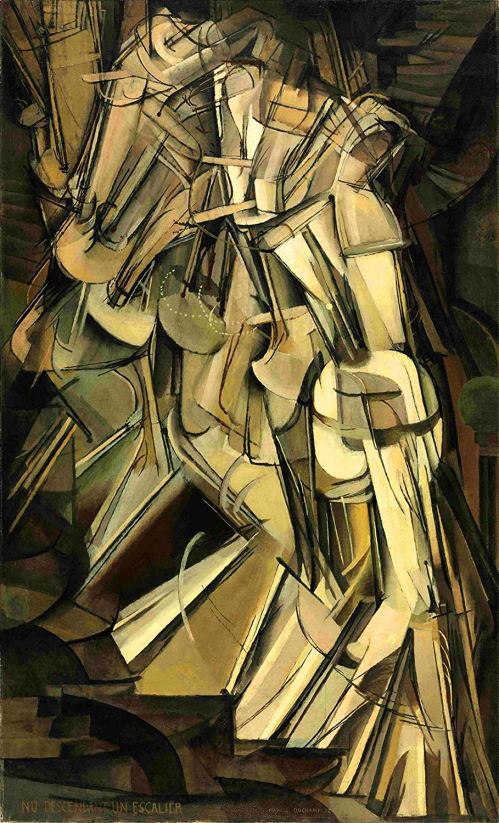
With this last act in our The Future of Art lessons, it is time to come full circle, connect the dots with Méliès and with me with a dollop of Duchamp thrown in because he was keen to poke a finger in the eye of retinal art. But, before he did, he painted one of the most famous and influential Cubist/Futurist images Nude Descending a Staircase (1912).
The optical effect is founded in Cubism with an added Futurist twist of motion in time. With the influence Eadweard Muybridges’ 1887 series The Human Figure in Motion along with an awareness of Étienne-Jules Marey early experiments with time-lapse photography, notice how the Nude approximates the blur one might see with time-lapse imagery.
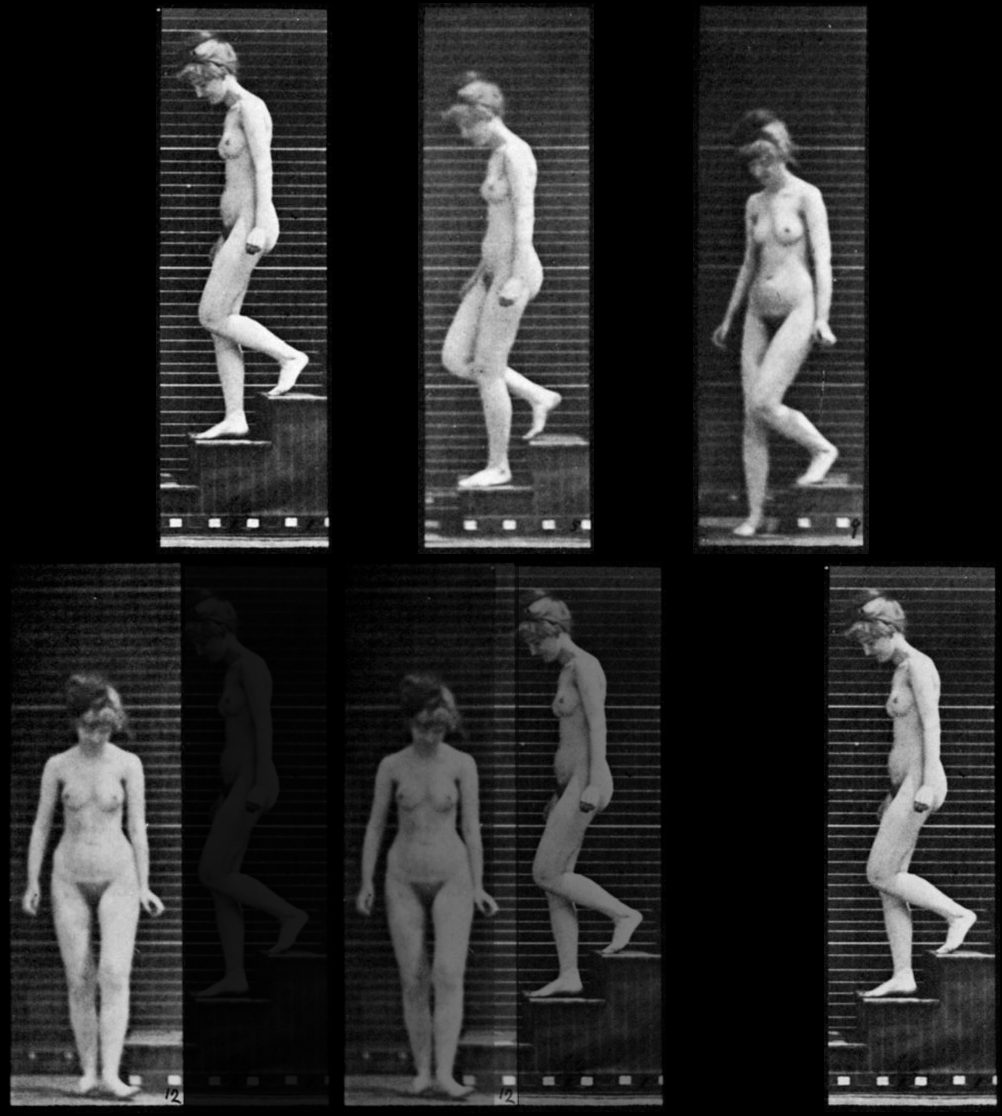
Even Duchamp himself got in on the descending act— on display until November 10 at the Legion of Honor in Strange Days: Dada, Surrealism and the Book Robert Lebel’s monograph Sur Marcel Duchamp (1959)

Painted in 1912, the same year as the Nude, Giacomo Balla’s Dynamism of a Dog on A Leash is one of the most famous Futurist paintings. The dachshund scurrying at the feet of a woman appears to be a stop-action, frame by frame capture of an energetic moment in time.

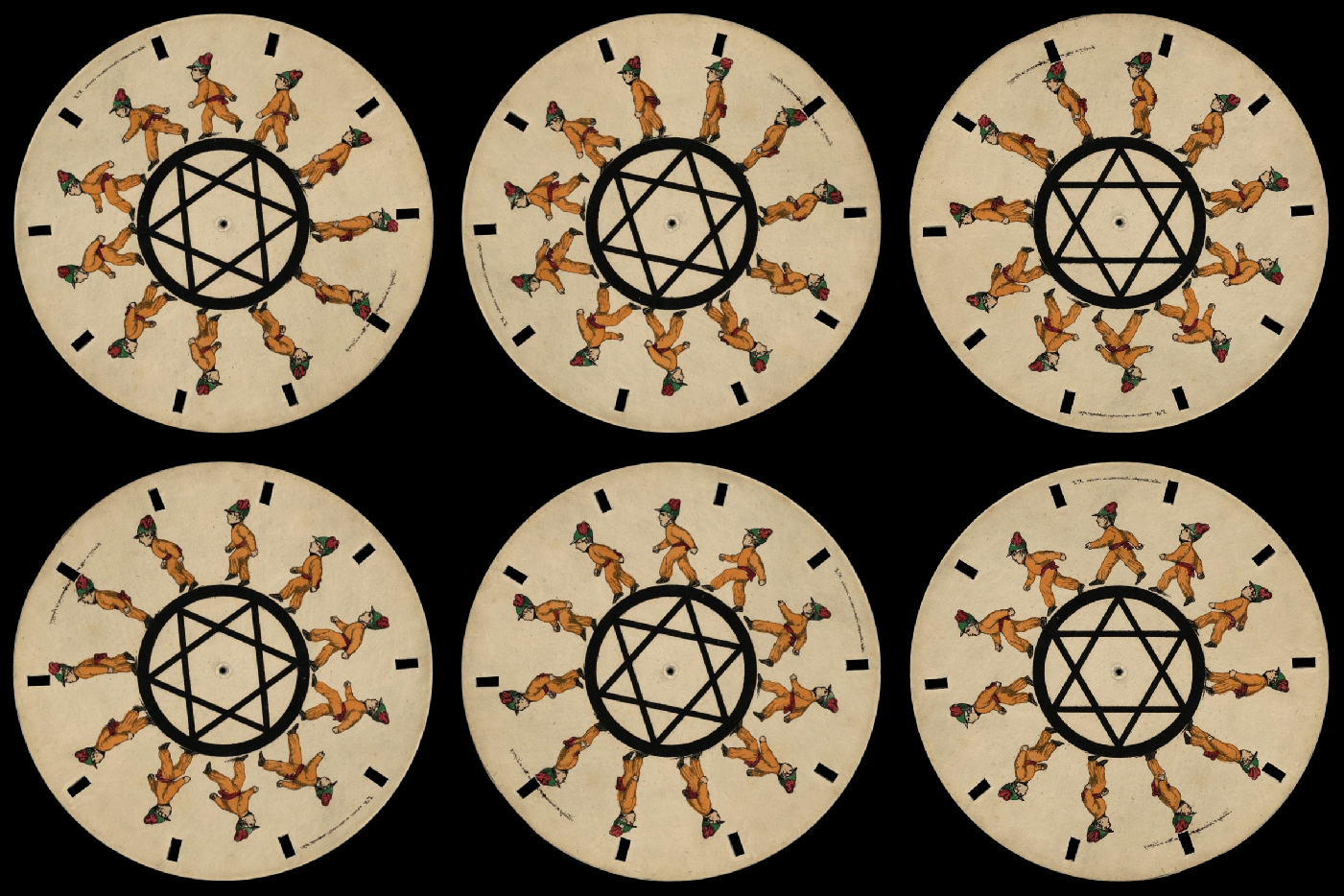
Many of the principles behind motion pictures were understood well before the invention of “the movies.”
In 1833 Simon Ritter von Stampfer experimented with stroboscope effects where images on a spinning disc appeared as if moving.
In 1877 photographer Eadweard Muybridge created a sequence of 24 images of a running horse, taken by 24 cameras and, dare I say, motion pictures were soon off and running.
In 1882 when Étienne-Jules Marey camera took bursts of sequential photographs, the basic building blocks for the creation of motion pictures were invented.
In 1888 Thomas Edison met Eadweard Muybridge then worked to create a camera and projection system that reproduced vision the way the phonograph he was working on reproduced sound.
In 1890 French theater director and magician Georges Méliès was the first true master of cinematic techniques. His A Trip to the Moon, (1902) became the first internationally successful motion picture, and the first science fiction film.
Movie mastermind Méliès’ animation and a number of his special effects are based on stop-motion photography. Mention must be made of the theory of the “persistence of vision” a somewhat controverisal idea that what we see is a subtle blend of what we are seeing now and what we just saw. A bridge connecting now and then makes things appear as if in motion.
Here is Méliès, sci-fi cinematic sensation A Trip to the Moon 1902. Talk about a vision of the future.!!!
 Future of Art