Buddha says to the hotdog vendor, “Make me one with everything!”
Do we see the flow of history, the flow of art history, as a developmental gyre always moving in a rising spiral? Having passed thorough the POMO’s (Post-modernism) “end of history” where the smarties of the world often eschewed a directional point as part of their philosophical gravitational pull—Welcome to Derrida’s pointless forest. Whether things move toward a point depends on where you are standing, and when you are standing in the pointless forest of POMO, YOU are the point, which leads to a lot of individuation though often masquerading as narcissism. It’s good to be finding our way out of the pointless forest. Glossing up Harry Nilsson’s animated film The Point where our star Oblio and his faithful hound Arrow make their way through said Pointless Forest in search of acceptance.
No, boys and girls we are not at the postmodernist’s “end of history”because there is no such thing. There is where we find the end of Deconstruction because there actually was no such thing as deconstruction. If we accept that art is a vital part of the human genome in action suddenly the confusions of Contemporary Art vaporize. We come back to our senses even though Deconstruction was a fun mental ride.
Since we’re talking in “Relative” terms here we come back to Einstein who said, “God does not play dice with the Universe.” Since everything in the universe is always in motion, where one stands is always in relationship to everything else. In terms of understanding Art we come back to the idea that maybe there actually is a point being that metaphorical thinking is a part of this human genome thing.
But that’s what we’ve come to, allowing the point of things to return. The arrival at a new devotion to the point we had to give up on coming to the point, wander through the Pointless Forest and back out to where the world becomes full of meaning once again—luminous, brightly revealing itself in endless wonder.
Good to eat, good to think as anthropologist Claude Levi-Strauss pointed out—we are nourished. Point taken.
Time. It rules our lives. Got to get here. Got to get there. Be on time. There is a never enough time to do the things we want and need to do. Is there a way to get more of it? Get up earlier? Go to bed later? Organize ones time better?
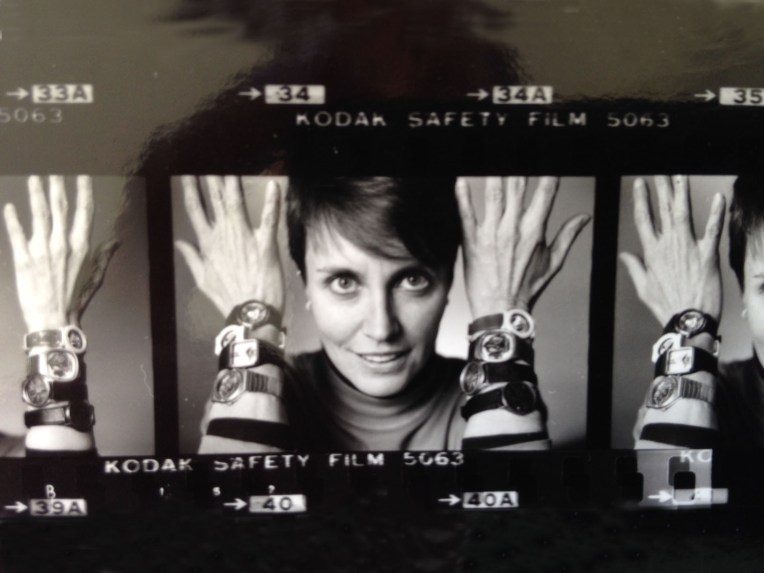
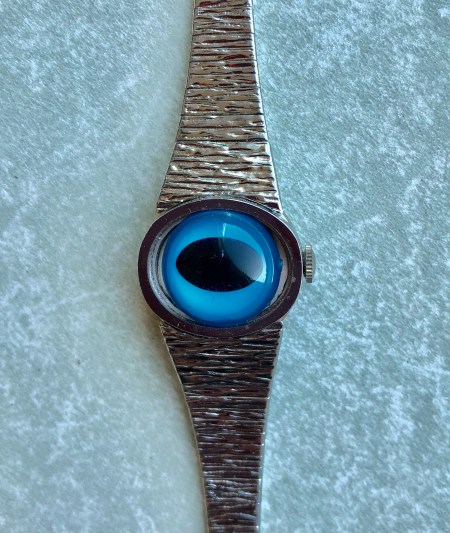
Stuck in a traffic jam, you are sweating late… your tension level is maxing out, then you glance down at your TimelinE watch and you can’t help but laugh. Yes, you are wearing a watch but it does not tell you the time in a chronological sense. It is asking you take a time out; take a deep breath; to think about what’s the big hurry.
The Timeless Void
To figure out the cause of my debilitating headaches that seared as if a red- hot poker had been stabbed down the base of my skull, I had tests and more tests — MRI, CT Scan. I’d checked off the list of home and folk remedies, but nothing would alleviate. Kaiser finally sent me to a psychologist to see if the problem was just in my head. The doctor and I talked and talked, trying to find some event that might have triggered the pain but nothing added up to the cause. He eventually thought that hypnosis might help to overcome my anxiety and stress. Along with the headaches, I was a frantic mess because there was too much to do and not enough time.
He did not give the suggestion that I could now perform complex tap dance routines or cluck like a chicken. Once he had induced the hypnotic trance, the doctor asked me to envision a huge clock whose face was expanding in all directions. It was Daliesque with the edges of the clock dripping, melting over the edge of the horizon. It continued to stretch out to a far far away and when it could go no further it snapped and at once there was total blackness. No clocks. No stars. No nothing.
What was I experiencing? Infinity? There were no images, no beginning, no end. Just time beyond all dimension. I was floating in a quivering blackness in what seemed to be an eternity; in what I had heard described as the “timeless void.” As the doctor gently brought me out of the trance, he cautioned that I should, in the next few days, be very careful. He could see that I had gone into some place deep and far away.
As I awoke to this new reality, my sense of time was distorted, askew. Clocks didn’t jive. The next day, while walking down the ward to teach my class at the Yountville Veteran’s Home, the clock on one wall said 2:45 while the clock on the opposite wall at 2:49 was near but not exactly. Several students were wearing watches so I asked them what time it was. A minute this way or that, but no two people had the same time. It affirmed my revelation that time was/is a consensus reality; an agreed upon construct. Class begins at 2:45 so everyone always shows up then.
Before I could even begin my lecture, in a flash, I was thunderstruck as proverbs (time flies, time heals) and measures (make and take, keep and spend) came to mind. As fast as I could, on a scrap of paper I jotted down the ideas and scribbled sketches. After class, I realized that I had to make these as metaphorical watches, that would instead of telling the time, would serve as reminders of the timeless void and the infinity of space/time.
As an inveterate thrift-store shopper, my first thought was to repurpose used watches replacing the inner workings with my own diminutive paintings and sculptures. However, sourcing enough used ones was problematic. Fortunately, I was able to find a watch casings and band distributor in New York City who was willing to sell parts wholesale to a small time dealer like me.
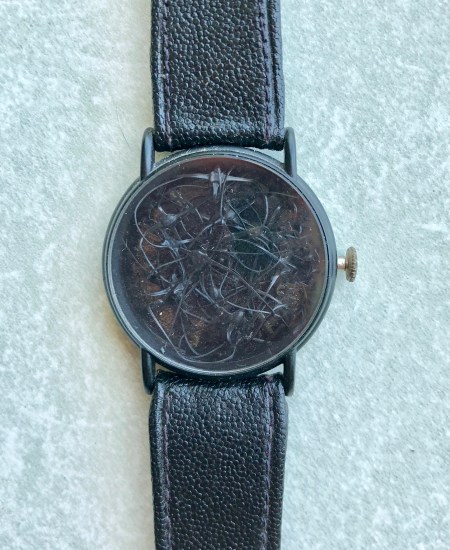
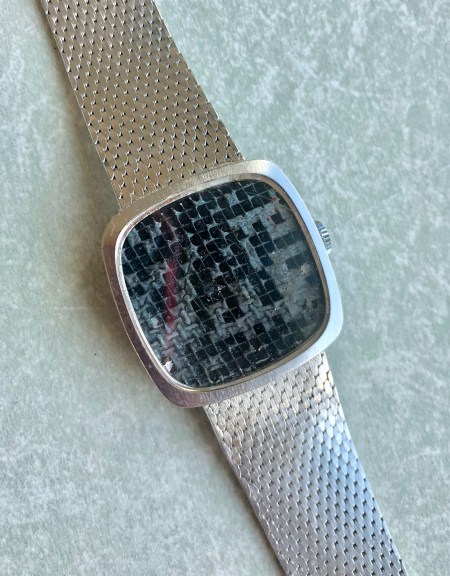
Inside the empty watch casing, contemporary rubble was paired with prehistoric fossils. Bits and pieces of detritus were marshaled into use. A piece of window screen became The Web of Illusion. A thicket of garden netting became the timeless void. A mouse skull, picked from the regurgitated remains of an owl pellet, inspired the Georgia O’Keeffe Watch. A doll hand smashed through the watch cover was Out of Time. Sartre was done proud with Being and Nothingness and the glass eyeball on Watch Watch is doing just that.
Web of Illusion
Each titled, signed, and dated watch was presented in a special box along with a label that described the philosophical intention of these meditative devices. They were featured in galleries in Napa, San Francisco, Los Angeles and New York. With articles in Glamour, SideStreet, The Chicago Tribune, I was busier than ever.
Did the hypnosis solve my anxiety or cure the headaches? Did the making of timeless timepieces ease my fret about time? No, not really. Making and then marketing the watches, added yet another thing to do in an already jam-packed life. But as a timeless interpretation of immeasurable metaphor the last question a TimelinE watch would ever answer, do you have enough?
Time present and time past are both perhaps present in time future…
From the Four Quartets …TS Eliot
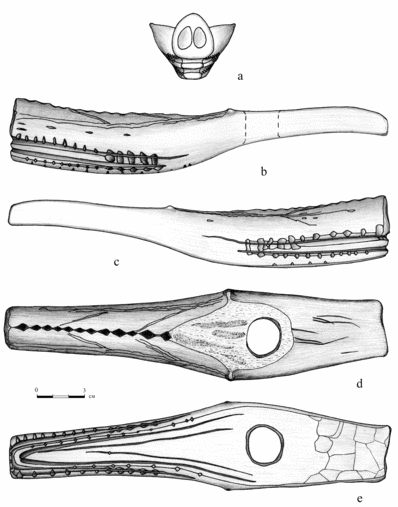
Locate. To fix a place, to establish a spot and here our purpose is to reach from our location now, into an unknown future. It looks from Alexander Marshack’s work defined in his TheRoots of Civilization, that the ability of humans to locate themselves in time was one of the great strides in the human project. Observations of lunar cycles were recorded on bone tablets or on spear throwers or other useful implements like arrow straighteners. Marshack, a journalist writing about the space program, deciphered the arcane marks fifty years ago.
It was essential for survival to know where in the solar cycle you were. To know by past observations, for example when to expect the return of the spawning salmon by knowing what time of year it was. A relatively cool or warm spring was an unreliable indicator of season. How would you know when it was time to head to your favorite fishing spot, or when was it time to be on the lookout for flocks of migrating geese? A calendar would turn out to be a great survival tool.
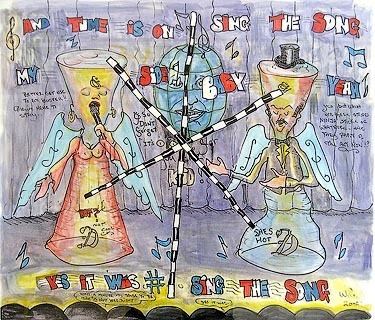
“Are you keeping time, or is time keeping you” says Wm Wiley’s famous character, the hourglass Buster Time. Here Buster appears as a song and dance team with wings to reference the flight of time.
Pierre Tielhard de Chardin (speaking of paleontologists—discoverer of Peking Man and more) predicted the future of humanity as moving toward a teleological end—the development of life as a spiritual project. “You are not a human being in search of a spiritual experience. You are a spiritual being immersed in a human experience…” de Chardin pointed out almost a century ago. He called this end the Noosphere or the Omega Point when biological processes evolve to spiritual awakening of the human body-mass when technology art and biology merge.
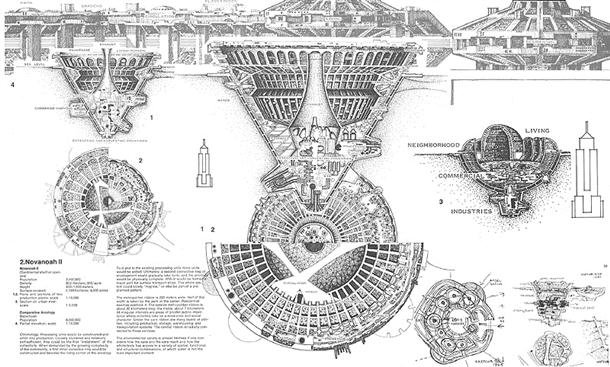
One of the thinkers in this merging was architect and artist Paolo Soleri.
Drawing for an integrated living system city. P. Soleri
Soleri’s city structures fully integrated art, science, economics, religion, agriculture— true structures of the coming noosphere. So, to talk about the future of art we are going back to a time when all human activity was an integrated whole. The debates about science and art, about religion and science, about economics and art all seem silly taken in the context of the Omega point. There is little doubt that the world is perfectly flowing in that direction. Perfectly flowing does not preclude human suffering because we all know that both tragedy and comedy are a part of the human genome. The creative mind is also part of the genomic tool kit. It’s bred in the bone as we like to say in our better moments.
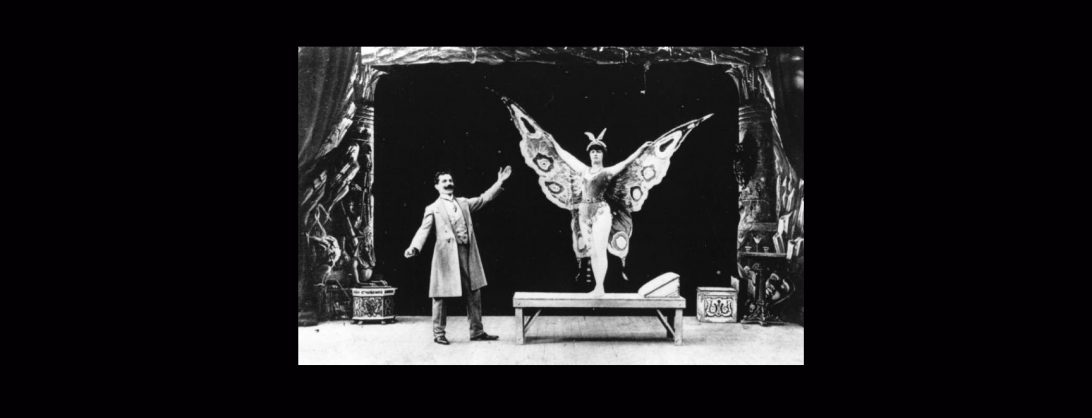
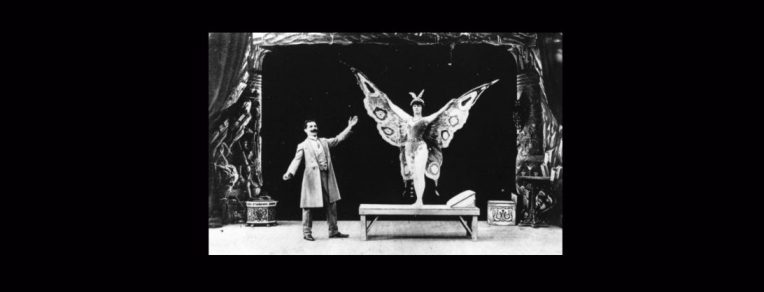
French actor/filmmaker Georges Méliès turning a sleeping woman into a butterfly.
Méliès was a hands-on artist, involved as director, writer, producer and set/costume designer in every stage of the performance production. He is credited with inventing as many as 30 new illusion tricks.
Méliès stands as an inspiring source for our Future of Art lessons. He could not have known what would transpire with magic and with moving pictures and how they would become the future.
 Future of Art